
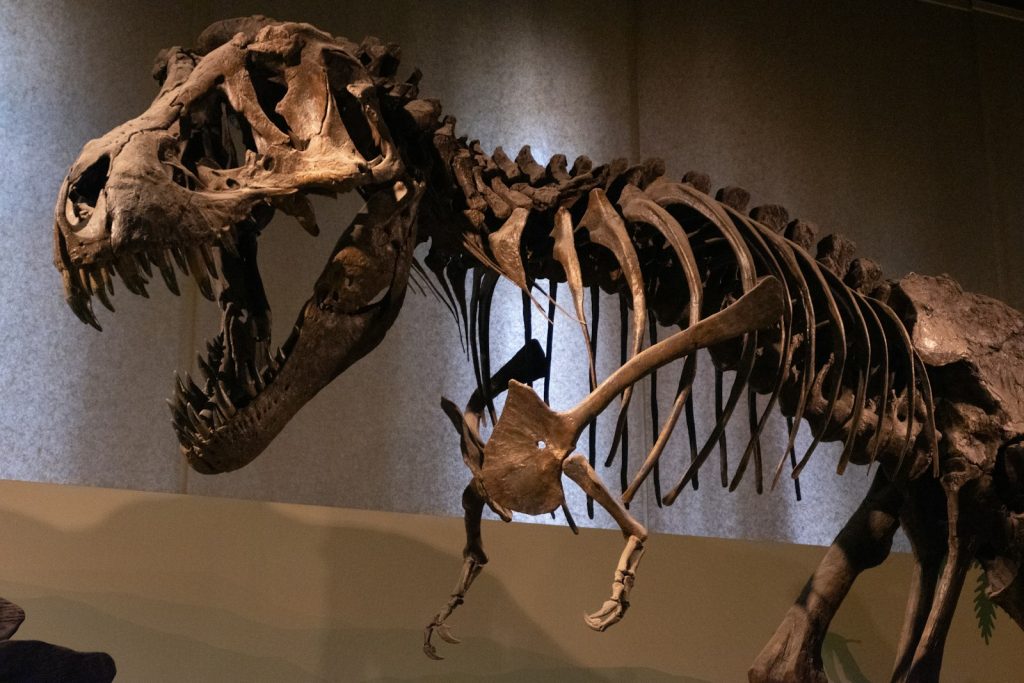

A 67-million-year-old Tyrannosaurus rex fossil nicknamed “Gus” just became the most expensive set of dinosaur bones in history, selling for a record $50.1 million at a Sotheby’s auction in New York. The sale caps a ten-minute bidding war between seven prospective buyers and instantly reshapes the market for one of the world’s most fearsome extinct predators.
Key Takeaways
- Gus sold for $50.1 million on July 14, 2026, the highest price ever paid for a dinosaur fossil at auction.
- The sale beat the previous record of nearly $45 million for the stegosaurus “Apex,” set by the same auction house in 2024.
- Gus is roughly 61% complete, with an exceptionally preserved skull, two well-represented feet, and a rare wishbone-like furcula.
- An anonymous phone bidder won after outbidding six others in a rapid-fire auction that nearly doubled the pre-sale estimate.
- Paleontologists are urging the new owner to donate Gus to an accredited museum so it remains available for scientific study.

1. A New Auction Record: $50.1 Million for “Gus”
Sotheby’s confirmed that the Gus fossil sold for $50.1 million on Tuesday, making it the most expensive dinosaur skeleton ever auctioned. The price easily surpassed the nearly $45 million paid for “Apex” the stegosaurus in 2024, and it dwarfs the $32 million paid for “Stan,” a T. rex skeleton auctioned in 2020 that had held the previous T. rex record.
Why it matters: The result confirms that demand for museum-grade dinosaur fossils keeps climbing, turning rare specimens into trophy assets that rival fine art and classic cars at the highest levels of the auction world.
2. Meet “Gus”: Inside the Fossil’s Specs
Standing upright with its tail extended, Gus measures about 12½ feet tall and 38 feet long. Sotheby’s describes the specimen as roughly 61% complete, featuring an “exceptionally preserved” skull with a gaping jaw of powerful teeth, two well-represented feet, and several rarely found bones including a furcula, or wishbone. The fossil was discovered in 2021 on a South Dakota ranch and named in honor of property owner Gary Licking, who died during the roughly five-year excavation, restoration, and mounting process.
Why it matters: Completeness and preservation quality directly drive auction value — the more of the original skeleton that survives intact, the more scientifically and financially valuable the specimen becomes.
3. Why the Bidding Got So Intense
Sotheby’s had estimated Gus would fetch between $20 million and $30 million ahead of the sale. Instead, the fossil nearly doubled that ceiling as seven bidders competed for roughly ten minutes. “Try a bigger bite,” auctioneer Phyllis Kao reportedly cajoled the room at one point. “It’s a T. rex, after all.” Cassandra Hatton, Sotheby’s vice chair, said afterward that “the market responds when great specimens are taken care of in the right way.”
Why it matters: The dramatic overshoot of the pre-sale estimate signals that collector appetite for elite fossils may be outpacing even expert predictions.
4. The Mystery Bidder and What Happens Next
The winning bidder, who participated by phone, has asked to remain anonymous, so it’s not yet known whether Gus will end up in a private collection or on public display. That uncertainty echoes past sales: “Sue” the T. rex, the first dinosaur ever sold at auction back in 1997, became a centerpiece of Chicago’s Field Museum, while “Stan” now stands at the Natural History Museum Abu Dhabi.
Why it matters: Where Gus ends up will determine whether the specimen continues to serve science and education or disappears into private hands.
5. Scientists Push for Public Display
The Society of Vertebrate Paleontology, an advocacy group of scientists and scholars, said fossils as scientifically significant as Gus should be displayed in museums and research institutions. “Our hope is that the new owner recognizes the extraordinary scientific and educational value of Gus the T. rex and that they aim to keep it in the public trust by immediately donating it to an accredited natural history museum,” said Kristi Curry Rogers, the society’s president-elect, in a statement.
Why it matters: Without public access, researchers lose the chance to study rare anatomical details, and the public loses a direct connection to prehistoric life.
6. How Gus Stacks Up Against Other Record Dinosaur Sales
Gus now tops a growing list of blockbuster fossil sales: “Sue” the T. rex sold for about $8.4 million in 1997; “Big John” the triceratops fetched nearly $8 million in 2021; “Stan” the T. rex brought in almost $32 million in 2020; and “Apex” the stegosaurus set the previous overall record at nearly $45 million in 2024. At $50.1 million, Gus resets the ceiling for the entire category.
Why it matters: The steady climb in prices across nearly three decades shows a fossil market that has moved from niche curiosity to a genuine luxury asset class.
7. T. Rex’s Enduring Pop-Culture Reign
Tyrannosaurus rex, whose name translates to “King of the Tyrant Lizards,” sat atop the food chain during the late Cretaceous period roughly 67 million years ago. With its fearsome jaw and famously stubby arms, it remains the most recognizable dinosaur on the planet, appearing everywhere from the purple children’s character Barney to the “Jurassic Park” film franchise.
The Bigger Picture Behind the Gus Sale
The Gus sale lands at a moment when natural history keeps generating headline-grabbing moments, from record fossil auctions to new discoveries about the universe itself. For more on how scientists are pushing the boundaries of what we know, see our coverage of a magnetar being born. Taken together, these stories show that public fascination with deep time — whether it’s dinosaur bones or dying stars — shows no signs of slowing down.
Frequently Asked Questions
Why did Gus sell for so much more than expected?
Sotheby’s had estimated $20 million to $30 million, but seven competing bidders drove the price to $50.1 million during a fast-paced, ten-minute auction.
Is Gus going to be displayed in a museum?
It’s not yet known. The winning bidder chose to remain anonymous, and paleontologists are publicly urging them to donate the fossil to an accredited museum.
How does Gus compare to other famous T. rex fossils like Sue and Stan?
Gus is now the most expensive dinosaur fossil ever sold, surpassing Stan’s $32 million (2020) and the stegosaurus Apex’s $45 million (2024). Sue, the first dinosaur sold at auction in 1997, went for about $8.4 million.



Pingback: Ark of the Covenant Mystery: Archaeologists Uncover 3 Stunning Clues at Biblical Shiloh - The Viral Minute