
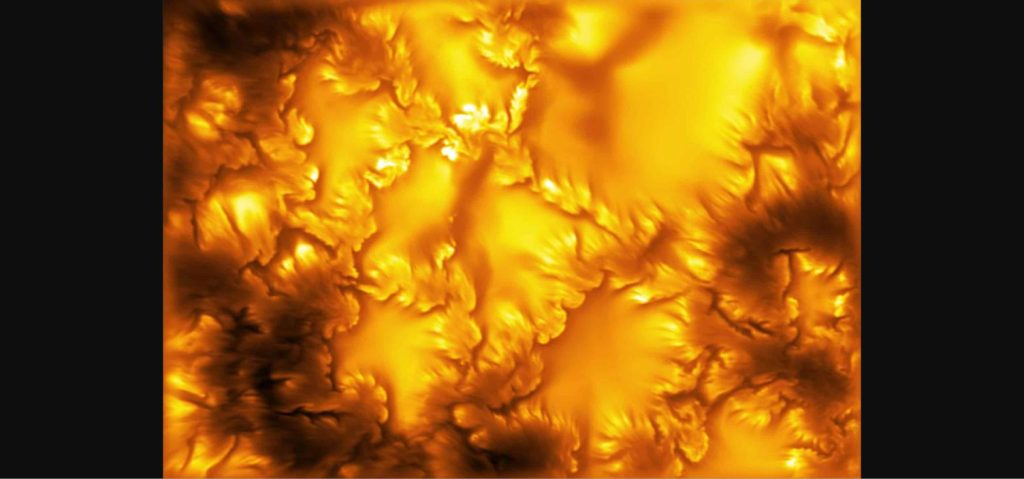

New Inouye Solar Telescope images and video have captured the highest-resolution view of the Sun’s surface ever recorded, revealing a hidden physical process that scientists say could explain how the Sun builds up the explosive energy behind solar flares. The National Solar Observatory (NSO), which operates the telescope in Hawaiʻi, announced the breakthrough on August 5, 2026, alongside a new paper in the journal Nature. Here are six key details behind the discovery, plus the new images and video released alongside it.
Table of Contents
1. The Discovery: Kelvin-Helmholtz Instability on the Sun
Researchers identified small, swirling, whirlpool-like patterns called Kelvin-Helmholtz instability (KHI) on the Sun’s surface, or photosphere. First described by Lord Kelvin and Hermann von Helmholtz around 1870, KHI occurs when two fluids slide past each other at different speeds, creating a shear that grows into wave-like vortices. This marks the first unambiguous confirmation of KHI on the Sun, a phenomenon long predicted by theory but never directly resolved until now.
2. How the Inouye Solar Telescope Images Were Captured
The images come from the NSF Daniel K. Inouye Solar Telescope, built and operated by the National Solar Observatory near the summit of Maui’s Haleakālā. Its four-meter mirror and advanced optics give it the resolving power to reveal ultra-fine structures on the Sun’s surface at scales of just tens of kilometers, details that were previously out of reach for any observatory.

Video: Kelvin-Helmholtz instability on the solar surface, captured by the NSF Inouye Solar Telescope. Credit: NSF/NSO/AURA/MPS.
3. An International Research Team
The discovery was made by scientists from the National Solar Observatory, the NSF NCAR High Altitude Observatory (HAO), and the German Max Planck Institute for Solar System Research (MPS). Their findings, titled “Ubiquitous Kelvin-Helmholtz Instabilities Driving Plasma Mixing on the Sun,” were published in the journal Nature on August 5, 2026.
4. Why the Swirls Matter: Space Weather
Scientists believe these swirling vortices could be a key driver of “flux braiding,” the process by which the Sun’s magnetic field lines twist around each other and build up tension. When that tension snaps and reconnects, it releases the energy behind solar flares and coronal mass ejections, the main contributors to space weather that can disrupt power grids, satellites, and GPS navigation, and even trigger events like the recent rare aurora borealis displays forecast across the U.S.
5. Simulations Matched the Real Observations
The team compared the Inouye observations with computer simulations built using the MURaM code, developed with the High Altitude Observatory and Max Planck Institute. Both the real data and the simulations showed vortices spaced roughly 50 to 65 kilometers apart, a striking agreement that confirms the physical mechanism behind the swirls and validates the simulation models scientists use to study solar and stellar plasma.
6. A Clue to the Corona Heating Mystery
The swirling effect also mixes magnetized and non-magnetized plasma on the Sun’s surface, which may help explain two long-standing puzzles: why the Sun’s outer atmosphere, the corona, reaches temperatures of over a million degrees despite being far from the Sun’s core, and how the Sun’s magnetic field diffuses quickly enough to complete its 11-year activity cycle. Researchers say the finding builds on other recent solar physics work, including the study of a newly observed magnetar birth that is reshaping how scientists think about stellar magnetic fields.
What Happens Next
Scientists are now developing automated tools to detect and measure Kelvin-Helmholtz vortices across the full archive of Inouye Solar Telescope images and data. This next phase of research aims to quantify how much energy these swirls carry into the Sun’s upper atmosphere and how strongly they influence magnetic field diffusion, work that could improve long-term space weather forecasting.
Frequently Asked Questions
What is the NSF Inouye Solar Telescope?
It is the world’s largest solar telescope, built and operated by the National Solar Observatory on Haleakālā, Maui, Hawaiʻi, under the U.S. National Science Foundation. Inouye Solar Telescope images are considered the sharpest views of the Sun’s surface ever taken.
What is Kelvin-Helmholtz instability?
It is a fluid dynamics effect that occurs when two fluids or gases slide past each other at different speeds, creating swirling, wave-like vortices. It is also seen in ocean waves, clouds, and the atmospheres of gas giants like Jupiter.
Why does this discovery matter for people on Earth?
Understanding how the Sun builds and releases magnetic energy helps scientists better predict space weather events, such as solar flares and coronal mass ejections, that can disrupt power grids, satellites, and communications on Earth.
Where was the research published?
The findings were published in the journal Nature on August 5, 2026, alongside an official announcement from the National Solar Observatory.



Pingback: Total Solar Eclipse 2026: 7 Stunning Facts Revealed