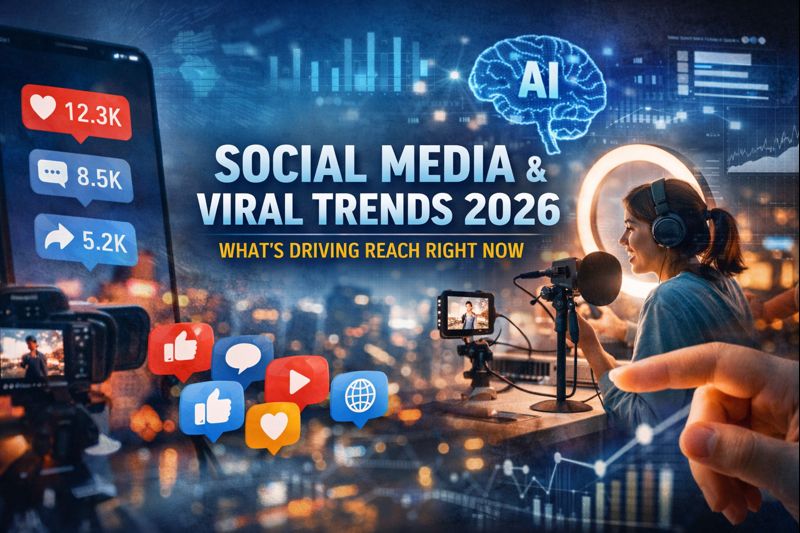

Social media and viral trend dynamics are shifting fast in 2026. Here’s what’s driving global reach, creator growth, and platform power right now.
Introduction
The rules of reach on social media are changing again—and faster than many brands, creators, and publishers expected. In early 2026, a clear pattern is emerging across platforms: virality is no longer just about volume, timing, or luck. It is increasingly engineered, platform-shaped, and tied to deeper signals of trust, behavior, and community relevance.
From short-form video saturation to AI-assisted content creation, the social media and viral trend ecosystem has entered a new phase. Algorithms are prioritizing signals that reward retention over raw clicks, credibility over noise, and sustained engagement over one-hit spikes. This matters now because billions of users are being subtly re-trained in how they discover information, culture, and even news.
The shift affects everyone—independent creators chasing visibility, brands investing millions in social strategy, and platforms fighting to retain attention amid regulatory pressure and user fatigue. What worked in 2023 or 2024 no longer guarantees reach in 2026. In some cases, it actively suppresses it.
This moment is pivotal. The platforms are still dominant, but their incentives are changing. So are user expectations. Understanding what’s driving viral momentum today—and what is quietly being deprioritized—has become essential for anyone who relies on social media for influence, income, or information distribution.
If you want a real-world snapshot of how fast trend cycles are moving, see our breakdown of 11 explosive moments driving culture in North America right now: https://theviralminute.com/viral-trends-on-social-media-11-explosive-moments-driving-culture-in-north-america-right-now/
Key Facts at a Glance
- Who: Global creators, media publishers, brands, platform operators
- What: A structural shift in how viral content is surfaced and sustained
- When: Accelerating through early 2026
- Where: Global, with notable differences across US, UK, and MENA markets
- Why it matters: Reach, revenue, and cultural influence are being redistributed
How the Social Media & Viral Trend Ecosystem Reached This Point
Why legacy virality models stopped working
For more than a decade, virality followed a familiar formula: post frequently, hook fast, optimize for shares, and ride the algorithm. That model peaked during the pandemic-era content boom. Since then, platforms have been flooded with near-identical formats, recycled trends, and AI-generated volume.
By 2025, engagement inflation had become a real problem. Users scrolled more but interacted less. Platforms responded by recalibrating what they considered “valuable” engagement—quietly shifting weight from surface metrics like likes and views toward deeper behavioral signals such as watch time, saves, rewatches, and off-platform sharing.
This recalibration has carried into 2026 with sharper enforcement.
What’s Driving Virality on Social Media in 2026
Retention beats reach
Across platforms like TikTok, Instagram, and YouTube, retention is now the single most consistent predictor of algorithmic lift.
Content that keeps users watching, reading, or swiping within a single creator’s ecosystem performs better than content that spikes briefly and fades. This explains why slower, story-driven videos and carousel-based explainers are outperforming rapid-fire trend hopping.
The social media and viral trend playbook now rewards creators who think in sequences, not posts.
Credibility signals are quietly ranking content
Platforms rarely say this openly, but trust is being scored. Accounts with consistent posting history, low misinformation flags, and stable audience behavior are seeing preferential distribution.
For news-adjacent content, especially, unverified claims or sensational framing may still spike—but they decay faster. In contrast, content that appears “safe” for recommendation ecosystems sustains longer visibility windows.
This is particularly visible on recommendation surfaces that feed into Google Discover-style discovery loops.
The Role of AI in Shaping Viral Trends
AI creation vs. AI curation
AI tools have dramatically lowered the barrier to content creation. In 2026, this has created a paradox: more content than ever, but fewer breakout hits.
Platforms are countering AI saturation by leaning harder on human behavioral feedback. AI may generate the content, but humans determine whether it spreads. Watch time, comments that show comprehension, and repeat exposure all act as filters against mass-produced noise.
The result is a two-tier system: AI helps creators scale, but only those who add original insight or narrative framing see sustained growth.
Regional Differences in Viral Behavior
United States and UK: fatigue meets selectivity
In mature markets, users are more selective. Trend cycles are shorter, but trust cycles are longer. Once an account is perceived as valuable, it enjoys disproportionate reach.
MENA: community-driven virality
In parts of the Middle East and North Africa, viral trends still lean heavily on community amplification—WhatsApp sharing, localized humor, and regional identity cues. Global formats succeed only when adapted, not copied.
Economic and Industry Impact
Brands are reallocating budgets
Performance marketing tied to viral spikes has become less predictable. As a result, brands are shifting spend toward long-term creator partnerships and owned-media amplification.
Creators face a consolidation moment
The middle tier is shrinking. Large creators with loyal audiences and micro-creators with niche authority are gaining ground. Those reliant on trend mimicry are losing visibility.
Platforms are defending ad ecosystems
Sustained engagement is more monetizable than fleeting virality. Platform algorithm changes reflect this financial reality.
What Happens Next for Social Media and Viral Trend Dynamics
Short-term (next 6–12 months)
- Continued algorithm tightening around trust and retention
- Fewer mass trends, more segmented viral loops
- Increased visibility for explainers, series, and contextual content
Medium-term (2027 outlook)
- Stronger integration between search, social, and recommendation engines
- More explicit creator credibility scoring
- Regulatory pressure shaping content moderation incentives
Risks and opportunities
Creators who fail to adapt may see sudden reach drops. Those who invest in clarity, consistency, and audience understanding stand to gain disproportionate influence.
Frequently Asked Questions
What is changing most about virality in 2026?
Retention and trust now matter more than raw views or shares.
Are viral trends still worth chasing?
Yes, but only when aligned with a creator’s existing audience and expertise.
Does AI-generated content still perform well?
Only when paired with human insight and original framing.
Which platforms offer the most organic reach right now?
Short-form video platforms still lead, but distribution is more selective.
How long do viral trends last in 2026?
Most peak faster and fade quicker, unless reinforced by community engagement.
Is global virality harder to achieve?
Yes. Localized relevance now outperforms one-size-fits-all trends.
What metrics matter most for growth?
Watch time, saves, repeat views, and meaningful comments.
Conclusion
The social media and viral trend landscape in 2026 is not collapsing—it’s maturing. Reach is no longer a volume game but a relevance game. Platforms are signaling, through their algorithms, that sustained value matters more than momentary noise.
For creators, brands, and publishers willing to adapt, this shift offers something rare in the attention economy: stability. For those who don’t, visibility will become increasingly fragile.
What Happened in Venezuela? US Strikes and the Capture of President Maduro
https://theviralminute.com/what-happened-in-venezuela-us-strikes-and-capture-of-president-maduro/



Pingback: NFL Streaming 2026: The Playoff Viewing Map Fans Need
Pingback: Interstellar Comet 3I/ATLAS Explained: Earth, Planets, and Its Path