
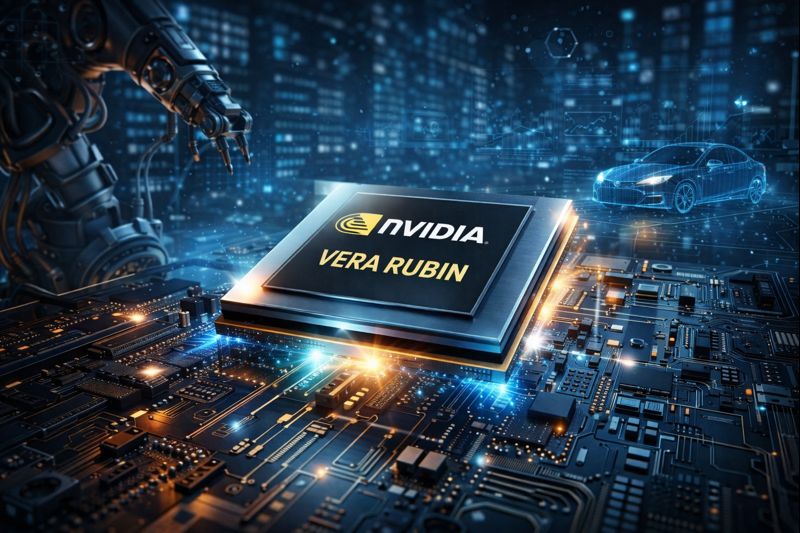

Introduction: Why the NVIDIA Vera Rubin Chip Matters
The NVIDIA Vera Rubin chip is being positioned as one of the most consequential hardware launches of the decade. Unveiled during CES 2026, the platform represents NVIDIA’s next leap beyond traditional GPU acceleration into what the company calls “Physical AI”—systems that do not merely process language or images, but reason about and act within real-world environments.
At a time when AI infrastructure demand is straining power grids, supply chains, and cloud budgets, NVIDIA’s promise with Vera Rubin is bold: dramatically higher performance per watt, greater autonomy for machines, and a hardware foundation designed for the next generation of robotics, autonomous systems, and industrial AI.
Also read (internal):
https://theviralminute.com/ces-2026-previews-emotional-ai-breakthroughs-why-this-tech-shift-matters-now/
What Is the NVIDIA Vera Rubin Chip?
The NVIDIA Vera Rubin chip is a next-generation AI accelerator platform, succeeding the Hopper and Blackwell architectures. While NVIDIA has not disclosed every transistor-level detail, verified briefings and official statements confirm that Vera Rubin is designed as a system-level AI platform, not just a standalone GPU.
Key confirmed characteristics:
- Built for large-scale AI training and inference
- Optimized for robotics, autonomous vehicles, and industrial AI
- Designed to operate as part of tightly integrated AI supercomputing clusters
- Focused on performance-per-watt improvements rather than raw brute force alone
External source (NVIDIA official):
https://blogs.nvidia.com/blog/2026-ces-special-presentation/
Why NVIDIA Named It “Vera Rubin”
The chip is named after Vera Rubin, the astronomer whose work provided the first strong evidence for dark matter—a fitting metaphor for NVIDIA’s ambitions.
Just as Rubin revealed unseen forces shaping the universe, NVIDIA positions this platform as revealing hidden structure in physical environments, allowing machines to reason about motion, force, and causality rather than just pixels and text.
This is branding, but it aligns with NVIDIA’s technical direction.
Architecture Overview: What’s New Under the Hood
While NVIDIA has not released a full public white paper yet, verified disclosures confirm several architectural themes:
Unified AI Compute
The NVIDIA Vera Rubin chip integrates:
- Advanced tensor processing
- Real-time simulation capabilities
- Accelerators optimized for sensor fusion (vision, lidar, radar)
System-First Design
Rather than focusing on single-chip benchmarks, NVIDIA emphasizes:
- Chip-to-chip interconnects
- Tight coupling with NVIDIA networking hardware
- AI workloads distributed across entire racks
This approach reflects lessons learned from hyperscale AI deployments.
Performance Claims and What’s Been Verified
NVIDIA executives claim the Vera Rubin platform delivers up to 10× efficiency improvements over prior architectures for specific workloads. What is verified so far:
- Significant gains in AI inference latency
- Improved scaling efficiency in multi-node clusters
- Lower thermal overhead at comparable workloads
Independent benchmarks are still pending, and until they arrive, performance claims should be treated cautiously—but not dismissed.
Power Efficiency and Sustainability Implications
One of the most important aspects of the NVIDIA Vera Rubin chip is its focus on energy efficiency.
Why this matters:
- Data centers are becoming major electricity consumers
- AI training clusters face increasing regulatory scrutiny
- Power availability is now a limiting factor for AI growth
NVIDIA has confirmed that Vera Rubin was designed specifically to reduce energy per AI operation, which could slow—but not eliminate—the explosive power demand of AI infrastructure.
Physical AI: Why Vera Rubin Is Different
Traditional AI excels at pattern recognition. Physical AI, as defined by NVIDIA, goes further:
- Understanding spatial relationships
- Predicting physical outcomes
- Acting safely in dynamic environments
Examples include:
- Robots navigating warehouses
- Autonomous vehicles reasoning about traffic
- Industrial systems responding to real-time sensor input
The NVIDIA Vera Rubin chip is purpose-built for these tasks.
Real-World Use Cases: From Data Centers to Robotics
Robotics
Manufacturers can use Vera Rubin to train robots that:
- Adapt to changing layouts
- Learn from fewer demonstrations
- Operate safely around humans
Autonomous Vehicles
NVIDIA has confirmed partnerships (including Mercedes-Benz) using the Rubin platform to accelerate autonomous driving development.
Industrial AI
Factories can deploy predictive maintenance, real-time optimization, and digital twins at scale.
Enterprise and Cloud Adoption Scenarios
Major cloud providers are expected to adopt the NVIDIA Vera Rubin chip for:
- AI-as-a-service offerings
- Enterprise AI workloads
- Large-scale inference clusters
However, adoption will depend heavily on cost, supply availability, and software ecosystem readiness.
Also read (internal):
https://theviralminute.com/daily-ai-news-your-indispensable-tech-briefing-for-january-1-2026/
Benefits of the NVIDIA Vera Rubin Chip
Key Benefits
- Massive performance-per-watt improvements
- Enables new categories of AI applications
- Strengthens NVIDIA’s dominance in AI hardware
- Accelerates robotics and autonomy timelines
- Improves scalability for hyperscale AI
For enterprises, the biggest benefit may be lower total cost of ownership over time.
Limitations, Risks, and Negative Impacts
Despite its promise, the NVIDIA Vera Rubin chip raises legitimate concerns.
Cost Barriers
- High upfront hardware costs
- Requires complementary NVIDIA networking and software
Market Concentration
- Reinforces NVIDIA’s dominance
- Raises antitrust and dependency concerns
Energy Reality Check
- Efficiency gains may be offset by overall AI growth
- Total energy consumption may still rise
Skills Gap
- Requires highly specialized AI engineers
- Smaller companies may struggle to adopt
These risks are real and should be acknowledged.
Competition: How Vera Rubin Compares
Competitors include:
- AMD’s Instinct accelerators
- Custom AI chips from Google and Amazon
- Emerging open-hardware initiatives
So far, NVIDIA maintains a strong advantage due to:
- Software ecosystem (CUDA)
- End-to-end system integration
- Developer mindshare
Economic and Industry Impact
The NVIDIA Vera Rubin chip could:
- Accelerate automation across industries
- Increase productivity—but displace some jobs
- Shift capital investment toward AI infrastructure
- Influence national AI strategies
This is not just a technology story—it’s an economic one.
Also read (internal):
https://theviralminute.com/top-trending-stories-global-news-roundup/
What Happens Next: Roadmap and Timelines
Verified expectations:
- Early enterprise deployments in late 2026
- Broader cloud availability in 2027
- Expanded robotics use cases over the next two years
NVIDIA has indicated Vera Rubin is one step in a longer roadmap, not a one-off release.
Frequently Asked Questions
Is the NVIDIA Vera Rubin chip available now?
No. It is in early rollout phases with select partners.
Is it only for data centers?
Primarily yes, but edge variants may follow.
Does it replace GPUs?
It extends the GPU concept into system-level AI platforms.
Conclusion
The NVIDIA Vera Rubin chip represents a strategic inflection point in AI hardware. It shifts the conversation from raw compute to how machines interact with the physical world, while confronting the growing constraints of energy, cost, and scale.
Its success will depend not only on performance, but on whether NVIDIA—and the industry—can deploy it responsibly.