
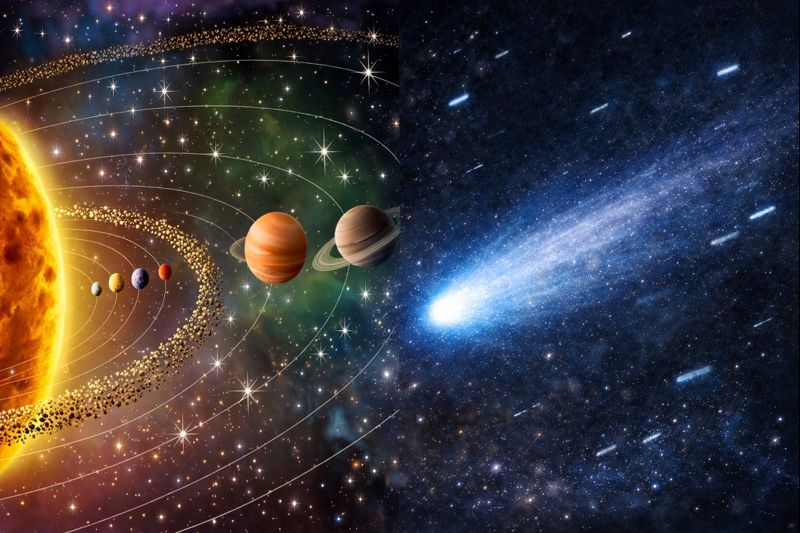

Introduction: Interstellar Comet 3I/ATLAS Takes Center Stage
Interstellar Comet 3I/ATLAS has become one of the most talked-about scientific events of 2026, capturing attention far beyond the astronomy community. As the object reaches peak visibility during its closest solar approach, scientists, amateur stargazers, and social media users alike are fixated on what makes this visitor so extraordinary. Unlike typical comets bound to our Sun, Interstellar Comet 3I/ATLAS originated outside our solar system, making it only the third confirmed interstellar object ever observed.
Its arrival comes at a moment when space discovery is colliding with viral culture, misinformation, and renewed interest in cosmic threats and possibilities. From serious astrophysics to speculative theories invoking Baba Vanga and extraterrestrial origins, 3I/ATLAS has become a global conversation.
What Is Interstellar Comet 3I/ATLAS?
Interstellar Comet 3I/ATLAS was first detected by the ATLAS (Asteroid Terrestrial-impact Last Alert System) survey, a NASA-funded early-warning system designed to spot potentially hazardous objects. Initial orbital calculations immediately raised alarms among astronomers—not because it posed a threat, but because its trajectory did not match any known solar system origin.
What makes it interstellar?
- Hyperbolic orbit: 3I/ATLAS is traveling too fast to be gravitationally bound to the Sun.
- Extreme velocity: It entered our system at tens of kilometers per second.
- Chemical signature: Early spectral analysis suggests composition unlike typical Kuiper Belt comets.
Explainer:
NASA — What Are Interstellar Objects?
https://science.nasa.gov/solar-system/comets/interstellar-objects/
Why 3I/ATLAS Is So Rare
Before 2017, interstellar objects were theoretical. Then came:
- ‘Oumuamua (2017) – cigar-shaped, non-cometary, highly controversial
- 2I/Borisov (2019) – a classic comet from another star system
- 3I/ATLAS (2026) – older, faster, and more chemically complex
Astronomers believe billions of interstellar objects pass through the galaxy, but only a handful pass close enough—and bright enough—for detection.
Also read:
ESA — Interstellar objects passing through our solar system
https://www.esa.int/Science_Exploration/Space_Science/Interstellar_objects
Peak Visibility: When and Where to See Interstellar Comet 3I/ATLAS
As of mid-January 2026, Interstellar Comet 3I/ATLAS is at peak brightness during its perihelion—the closest point to the Sun.
Viewing highlights:
- Best hemisphere: Northern Hemisphere
- Tools required: Large binoculars or small telescopes
- Visibility window: Early evening skies, weather permitting
Astronomers caution that visibility will fade rapidly as the comet exits the inner solar system, never to return.
Scientific Goldmine: What 3I/ATLAS Can Teach Us
1. How planetary systems form
Because Interstellar Comet 3I/ATLAS formed around another star, its ice and dust offer direct clues about alien planetary systems.
2. Organic chemistry beyond the Sun
Early data hints at complex carbon-based molecules—fueling research into prebiotic chemistry across the galaxy.
3. Galactic migration
Tracking its path helps model how stars exchange material across the Milky Way.
Explainer:
Harvard–Smithsonian Center for Astrophysics — Tracking interstellar comets
https://www.cfa.harvard.edu/research/interstellar-objects
Why Social Media Is Obsessed With 3I/ATLAS
Search spikes around Interstellar Comet 3I/ATLAS mirror patterns seen during major celestial events—but with added conspiracy energy.
Trending themes include:
- “Visitors from space” theories
- Baba Vanga predictions resurfacing
- AI-generated visuals exaggerating brightness
This is a textbook example of science colliding with virality.
Also read:
Social Media & Viral Trends 2026: What’s Driving Reach Right Now
https://theviralminute.com/social-media-viral-trends-2026-whats-driving-reach-right-now/
Separating Science From Speculation
Despite viral claims, scientists are unequivocal:
- No artificial structure detected
- No trajectory change
- No radio signals
NASA and ESA stress that Interstellar Comet 3I/ATLAS is a natural object, though its age may predate our solar system itself.
Explainer:
NASA — ‘Oumuamua and the search for interstellar visitors
https://www.nasa.gov/feature/oumuamua-the-first-known-interstellar-object-to-visit-our-solar-system
The Broader Context: Why Space Stories Are Dominating 2026
The fascination with Interstellar Comet 3I/ATLAS is part of a wider shift:
- Renewed space investment
- AI-assisted astronomy
- Public anxiety around global instability
Space feels simultaneously distant and urgent.
Stay ahead:
CES 2026 Previews Emotional AI Breakthroughs: Why This Tech Shift Matters Now
https://theviralminute.com/ces-2026-previews-emotional-ai-breakthroughs-why-this-tech-shift-matters-now/
What Happens Next?
After perihelion, Interstellar Comet 3I/ATLAS will:
- Rapidly dim
- Exit the inner solar system
- Continue its journey through interstellar space
However, the data collected will fuel years of peer-reviewed research.
Astronomers are already preparing for the next interstellar visitor—now believed to be more common than once thought.
FAQs About Interstellar Comet 3I/ATLAS
Is Interstellar Comet 3I/ATLAS dangerous?
No. It poses zero risk to Earth.
Is it older than our solar system?
Likely yes, based on isotopic analysis.
Will it return?
No. Its trajectory means it will never come back.
Can amateurs observe it?
Yes, with proper equipment and dark skies.
Conclusion: A Rare Messenger From Another Star
Interstellar Comet 3I/ATLAS is more than a fleeting spectacle—it’s a physical message from another planetary system, offering insight into how worlds form across the galaxy. Its brief visit reminds us that our solar system is not isolated, and that discovery often arrives unannounced, traveling millions of years just to pass through our skies.
As 3I/ATLAS fades from view, its scientific impact is only beginning.