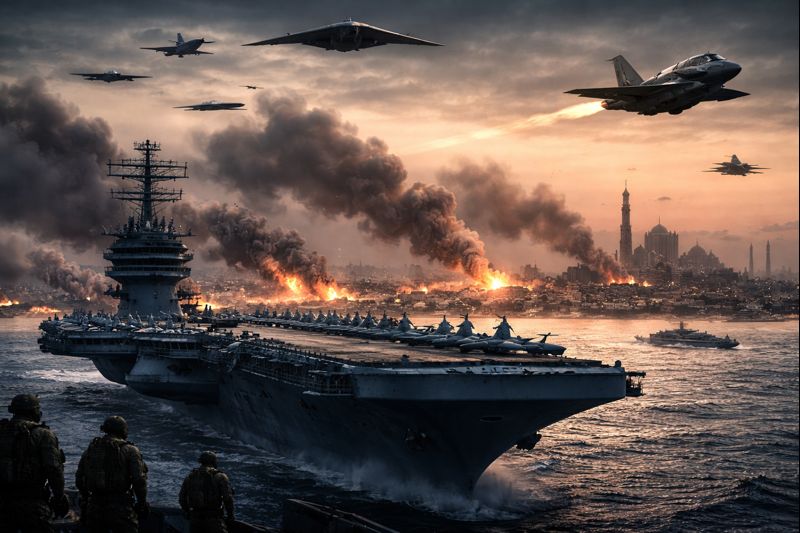

Today is Sunday, February 1, 2026. The world stands at a terrifying precipice. This US Iran Israel Conflict 2026 Update provides a comprehensive deep dive into the most volatile geopolitical standoff of the decade. From the arrival of a massive U.S. naval armada in the Arabian Sea to the smoldering ruins of the Natanz nuclear facility, the “Maximum Pressure 2.0” campaign has reached its final, most dangerous phase.
Executive Summary Where the US Iran Israel Conflict 2026 Update Stands Today
By early 2026, the Middle East has entered one of its most fragile periods in decades. A year of military strikes, political gambits, and internal unrest has left the region suspended between uneasy restraint and the risk of sudden escalation.
The aftershocks of last summer’s brief but devastating war continue to reverberate. Iran’s nuclear infrastructure suffered severe damage, yet its leadership survived — weakened, isolated, and increasingly focused inward. Economic pressure, widespread protests, and rolling communication blackouts have reshaped daily life inside the country, exposing deep fractures between the state and its population.
At the same time, Washington’s posture has hardened. A series of decisive actions abroad has reinforced the message that diplomatic patience now comes with sharper consequences. In the Middle East, that message has been read clearly — by allies watching nervously from the Gulf, by adversaries recalculating their limits, and by mediators racing to keep channels open before the next misstep closes them entirely.
Israel, operating under the belief that time no longer favors restraint, has continued to signal readiness for further action if red lines are crossed. Regional powers are responding in kind — reinforcing defenses, repositioning naval assets, and quietly preparing for scenarios few publicly acknowledge.
This moment is defined less by open warfare than by brinkmanship: calculated pressure, strategic ambiguity, and the constant risk that one miscalculation could ignite a wider conflict. Whether the coming months bring negotiated compromises or another descent into violence will depend on decisions made under extraordinary strain — in Tehran, Washington, Jerusalem, and the capitals watching from the sidelines.
Chapter 1 The Shadow of June 2025 — Operation Rising Lion and Its Aftermath
The US Iran Israel Conflict 2026 Update cannot be understood without revisiting Operation Rising Lion, the June 2025 campaign that reshaped the region’s security landscape.
Origins of Operation Rising Lion
On 13 June 2025, Israel launched an unprecedented pre-emptive strike on multiple Iranian nuclear and military facilities — including Natanz, Fordow, and other IRGC command centers — triggering an explosive escalation. Military analysts described this as one of the most significant direct confrontations between Israel and Iran in decades.
That first wave of attacks was coordinated with advanced intelligence operations deep inside Iran. Covert units reportedly disrupted Iranian missile launchers and air defenses, easing the path for Israeli aircraft to hit strategic targets.
US Involvement Operation Midnight Hammer
As part of the same US Iran Israel Conflict 2026 Update, the United States later joined the air campaign with its own offensive dubbed Operation Midnight Hammer on 22 June 2025, deploying B-2 stealth bombers and Tomahawk missiles against nuclear sites at Fordow, Natanz, and Isfahan.
• Fordow suffered near-total destruction from precision bunker-busting strikes
• Natanz was heavily damaged and likely set back in its enrichment efforts
• Isfahan faced structural damage, degrading its nuclear research capabilities
Experts from the International Atomic Energy Agency termed the damage “enormous,” underscoring the operation’s effectiveness at slowing Iran’s nuclear advances.
Iranian Retaliation and the Ceasefire
Iran responded with waves of missile strikes and rockets at Israel and US bases, including an attack on Al Udeid Air Base in Qatar. These escalations marked a dangerous expansion of conflict beyond Iranian borders.
Despite the ferocity, a ceasefire was brokered by late June 2025, halting major hostilities but leaving unresolved tensions simmering across the region.
Key Military Movements — June 2025
- Israeli strikes on Iranian nuclear sites (Natanz, Fordow, Isfahan)
- US deployment of B-2 bombers and Tomahawk missiles
- Iranian ballistic missile barrages in retaliation
- Missile attack on US Al Udeid Air Base
Diplomatic Milestones — Mid-2025
- Rapid Israeli-Iran escalation
- US intervention under Trump guidance
- Region-wide calls for de-escalation from global powers
- Ceasefire agreed but fragile
Chapter 2 The Venezuela Precedent — Maximum Pressure 2.0 and Middle East Policy
In January 2026, the US removal of Nicolás Maduro from power in Venezuela sent shockwaves through global foreign policy circles. The event — often framed as a decisive blow against a long-standing ally of Tehran — signaled a resurgence of the so-called “Maximum Pressure 2.0” approach to adversarial regimes.
Politically, this was more than symbolic. It demonstrated a willingness to use military force, sanctions, and diplomatic isolation in tandem — a strategy that has since been echoed in the US stance toward Iran. Under the Trump administration, this evolved into a broader doctrine of pressure aimed at forcing Tehran to the negotiating table or to collapse internally.
This approach drew criticism for its unilateralism and risks of unintentional escalation. Gulf partners like Saudi Arabia and the UAE supported diplomatic pressure but cautioned against broad military campaigns — fearful of regional destabilization and the impact on energy markets.
the Venezuela precedent that reshaped U.S. foreign policy
Chapter 3 The Internal Collapse — Protests, Blackouts, and the IRGC’s Grip
By early 2026, unrest inside Iran had become one of the most volatile aspects of the US Iran Israel Conflict 2026 Update.
Nationwide Protests and Crackdowns
What began as protests over economic hardship quickly morphed into existential challenges to the clerical regime. According to rights groups, thousands have died, and tens of thousands have been detained.
The government’s response was violent and comprehensive:
- Mass arrests nationwide
- Internet blackouts to prevent mobilization and outside reporting
- Heavy deployment of IRGC and Basij militia units
The internet blackout in June 2025 — a tactic to suppress dissent — re-emerged in 2026, effectively reducing digital communication by over 90% during peak protest periods.
https://www.reuters.com/world/middle-east
Economic Collapse and Public Sentiment
Iran’s economy, already battered by sanctions and the aftermath of Operation Rising Lion, continued to deteriorate. Unemployment, inflation, and falling currency values added to public frustration. This economic squeeze, combined with political repression, deepened the domestic crisis, placing additional pressure on the Iranian leadership from both the street and overseas.
IRGC Struggles with Control
The IRGC (Islamic Revolutionary Guard Corps) remained the backbone of the regime’s internal security strategy. Yet, widespread unrest revealed cracks in its control strategy, pushing the institution into a delicate balance between repression and avoiding total breakdown.
According to Reuters’ Middle East coverage
https://www.reuters.com/world/middle-east
Chapter 4 The Red Lines of 2026 — What Demands Are on the Table
The US Iran Israel Conflict 2026 Update is heavily influenced by what each side defines as its red lines. These include:
US and Allied Demands
- Complete dismantling of Iran’s nuclear weapons development capacity
- Permanent nuclear freeze under international supervision
- Reduction of ballistic missile inventories
- Proxy militias disarmament (including support for Hezbollah, Hamas)
Iranian and Allied Red Lines
- Defense of national sovereignty against foreign coercion
- Rejection of external ultimatums that threaten territorial integrity
- Continuation of civilian nuclear development
- Support for regional proxies as part of ideological strategy
Diplomatic efforts — including overtures from Ali Larijani and Qatar-mediated discussions — signal that there may be a narrow window for negotiation, but trust deficits remain steep.
Chapter 5 Regional Impact — Gulf States, Oil Markets, and the Armada
The US Iran Israel Conflict 2026 Update is not occurring in a vacuum. Saudi Arabia, the UAE, and other Gulf states are watching closely, balancing between alliance commitments and economic self-interest.
Naval Presence in the Strait of Hormuz
The Strait of Hormuz — through which a significant portion of the world’s oil supply flows — has become a strategic flashpoint. Iranian naval drills in the strait in early 2026 drew warnings from the US Navy and bolstered the deployment of the USS Abraham Lincoln Carrier Strike Group to the Gulf.
Risks to Oil Markets
Heightened tensions contribute to oil price volatility. Citi analysts point to a risk premium related to U.S. and Israeli pressure against Iran that could persist if crisis conditions deepen.
Saudi Arabia’s cautious diplomacy reflects concerns that further escalation could disrupt global supply chains and dampen investment in the region’s energy infrastructure.
BBC background reporting shows
https://www.bbc.com/news/world-middle-east
Chapter 6 Scenarios for the Spring — Diplomatic Paths or Conflict Spiral
Looking at the US Iran Israel Conflict 2026 Update, three primary scenarios emerge for Spring 2026:
Scenario 1 — Grand Bargain through Mediation
Qatar and Turkey could broker talks that lead to:
- A phased reduction of sanctions
- A renewed nuclear agreement similar to the JCPOA model
- Confidence-building measures like prisoner exchanges
This pathway, though fragile, offers a route to de-escalate without military action.
Scenario 2 — Decapitation Strike on Tehran
Under hardline strategic thinking, U.S. or Israeli forces could:
- Conduct targeted strikes against regime leadership or nuclear sites
- Attempt to cripple Iran’s command infrastructure
This option carries high risk of massive retaliation and widening conflict.
Scenario 3 — Prolonged Regional Proxy War
If diplomatic avenues fail and direct strikes are avoided:
- Iran could deepen support to Hezbollah and other proxies
- Israel could intensify operations in Lebanon and Syria
- Gulf militias and Shia groups might expand influence
This could result in a fragmented conflict spanning multiple theaters.
Timeline of Escalation June 2025 to February 2026
| Date | Event |
|---|---|
| 13 June 2025 | Israel launches pre-emptive strikes on nuclear sites in Iran. |
| 21–22 June 2025 | US B-2 bombers strike Iranian nuclear facilities. |
| 23 June 2025 | Iran fires ballistic missiles at Al Udeid Air Base. |
| Late June 2025 | Ceasefire agreed under US pressure. |
| Late 2025 | Maximum Pressure 2.0 sanctions and economic measures deepen. |
| Jan 2026 | Nationwide protests in Iran intensify; internet blackouts. |
| Jan 2026 | USS Abraham Lincoln deployed to Gulf amid heightened threat. |
| Jan 2026 | Progress reported toward US-Iran negotiations. |
| Feb 2026 | Iran’s Supreme Leader warns against any US-Israel attack. |
Conclusion The Future of the Middle East Axis of Resistance
The US Iran Israel Conflict 2026 Update paints a picture of a region on fragile footing. With domestic unrest eroding Tehran’s internal stability, economic strife tightening its grip, and strategic pressure from the US and its allies mounting, Iran faces a multi-front challenge.
Yet despite military setbacks, the regime retains its geopolitical influence through proxy networks and ideological ties across the Middle East. Whether this axis of resistance survives as a coherent bloc or fractures under pressure will shape the trajectory of global security well beyond 2026.
What emerges next — negotiated peace, expanded conflict, or a hybrid form of cold war with periodic hot flashes — will continue to define the Middle East’s future landscape.
also read