
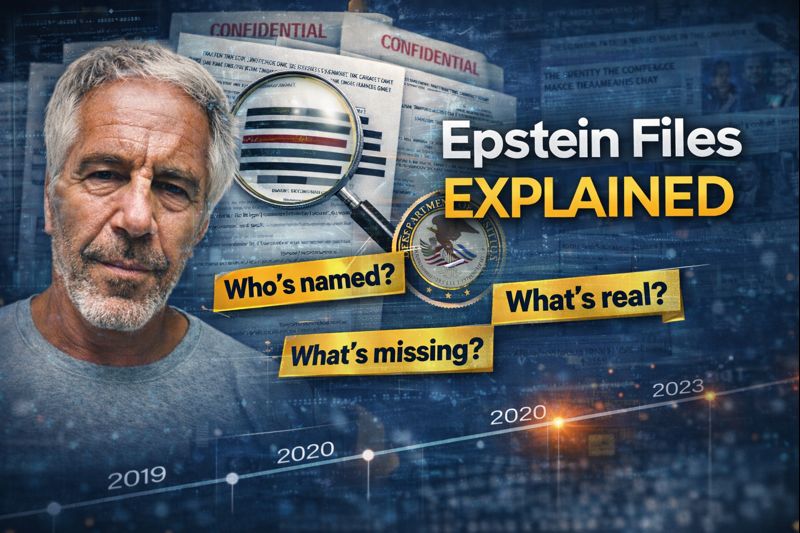

If it feels like the Epstein files keep resurfacing every few months, you’re not wrong—and you’re not alone in wondering why. Each new document release, court order, or headline triggers a familiar wave of confusion, outrage, and speculation. Social feeds fill with screenshots and claims, but clarity often disappears just as quickly.
The truth is less dramatic than the internet suggests—and more important.
The latest surge in interest comes from newly unsealed court documents tied to long-running DOJ-related litigation, not from a fresh criminal case. No new arrests. No secret “client list.” What has emerged is another piece of a much larger, unfinished puzzle—one that continues to raise questions about power, accountability, and how justice works when the accused never stands trial.
What People Mean When They Say “The Epstein Files”
Despite how the phrase is used online, the Epstein files are not one single document or database.
Instead, they’re a loose, unofficial label for thousands of pages of material that have surfaced over time, including:
- Civil court filings from survivor lawsuits
- Depositions and testimony connected to Ghislaine Maxwell
- Contact lists, calendars, and flight records
- DOJ and FBI evidence logs referenced in court
These documents come from different cases, different years, and different legal contexts. That’s why reading them without background can be misleading.
What Was Actually Released This Time—and What Wasn’t
According to court records, the latest Epstein files release stems from court-approved unsealing tied to long-running civil litigation, not from a new criminal indictment by the Department of Justice.
Here’s what matters:
- These documents do not announce new charges
- Many names appear due to third-party mentions, not accusations
- Courts explicitly warn that inclusion does not imply guilt
This is routine legal housekeeping—not a bombshell prosecution.
Jeffrey Epstein: The Case That Never Reached Trial
Jeffrey Epstein was arrested in 2019 on federal sex trafficking charges and died in jail before his case could go to trial. That fact defines everything that followed.
Because there was no verdict, no cross-examination, and no final ruling, many allegations were never tested in court. The absence of legal closure is one reason public interest hasn’t faded—and why documents continue to be scrutinized years later.
Trump and the Epstein Files: Separating Fact From Viral Claims
As reported by Reuters, Donald Trump was interviewed by investigators during earlier Epstein-related inquiries but has never been charged or accused by federal prosecutors.
What is confirmed:
- Donald Trump and Epstein socialized in overlapping elite circles in the 1990s
- Trump was interviewed by investigators
- Trump later publicly distanced himself from Epstein
What is not confirmed:
- Trump has not been charged
- No DOJ finding links him to Epstein’s crimes
- His name appearing in documents is not evidence of wrongdoing
These distinctions matter—especially in a legal context.
👉 https://www.reuters.com/world/us/
Prince Andrew and Why His Case Is Different
Unlike most figures connected to Epstein by association, Prince Andrew faced direct legal consequences.
He denied allegations but reached a civil settlement with Virginia Giuffre, resulting in:
- Loss of royal duties
- Severe reputational damage
- Permanent public scrutiny
This outcome highlights an important point: when evidence rises to a certain threshold, consequences follow—even without criminal conviction.
The civil settlement involving Prince Andrew followed years of scrutiny and resulted in the loss of royal duties, a development extensively documented by the BBC.
Ghislaine Maxwell: The Only Conviction So Far
Ghislaine Maxwell remains the only person convicted in connection with Epstein’s trafficking operation. In 2021, she was found guilty on multiple counts and sentenced to 20 years in federal prison.
Her conviction is often overshadowed online, but legally, it is the clearest accountability outcome in the entire saga.
Why So Many Famous Names Appear in the Epstein Files
Epstein deliberately positioned himself among powerful people—finance, politics, academia, media, entertainment. That was part of how he operated.
As a result, the documents include:
- Celebrities
- Business executives
- Politicians
- Media figures
But presence in a document does not establish knowledge, intent, or participation. Courts repeatedly caution against assuming otherwise.
Why the Epstein Files Keep Trending Years Later
Three forces keep pulling this story back into the spotlight:
- Staggered document unsealing over time
- Public distrust of elite institutions
- Algorithm-driven outrage cycles that reward implication over nuance
Each new release feels explosive, even when it contains material that’s years old.
The Real Risk: When Everything Becomes “Evidence”
There’s a hidden cost to treating every mention as proof.
- Survivors deserve justice grounded in facts, not speculation
- Innocent people deserve protection from unfounded claims
- Due process matters—even in emotionally charged cases
When documents are misread, the result isn’t accountability—it’s noise.
What Happens Next With the Epstein Files
Looking ahead, expect:
- More court debates over what should remain sealed
- Continued civil litigation tied to Epstein’s estate
- Ongoing political pressure for transparency
What you shouldn’t expect is a sudden wave of new criminal prosecutions. Legally, that window largely closed with Epstein’s death.
FAQs: Epstein Files, Answered Clearly
What are the Epstein files?
They are a collection of court documents, testimony, and records from multiple cases—not a single official file.
Were new crimes revealed?
No. The latest releases did not introduce new criminal charges.
Does being named mean someone did something illegal?
No. Courts explicitly state that mentions do not imply guilt.
Is there a secret Epstein client list?
No verified list exists.
Why is this still news in 2026?
Because documents continue to be unsealed and public trust in institutions remains fragile.
The Bottom Line
The Epstein files are unsettling, complicated, and emotionally charged—but they are not a shortcut to truth. Understanding them requires context, patience, and restraint in a media environment that rarely rewards any of those things.
What keeps this story alive isn’t just what’s in the documents—it’s what never got resolved.
And until people understand that difference, the searches won’t stop.
also read