
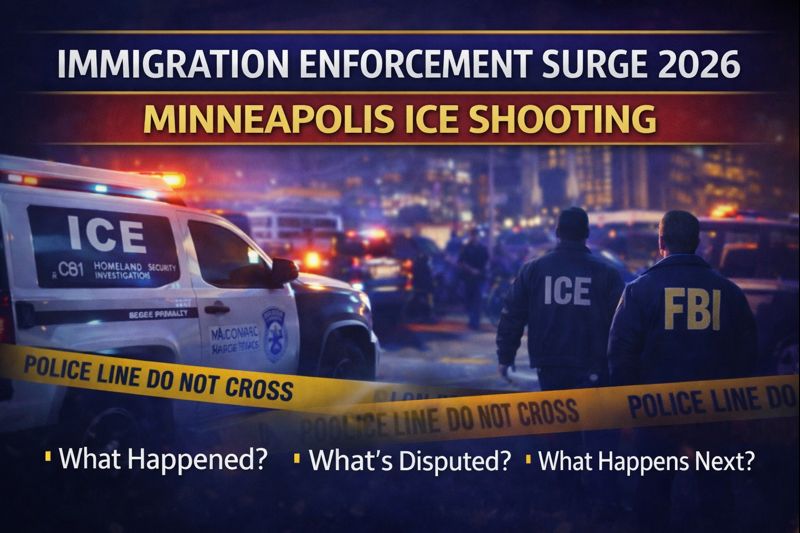

The immigration enforcement surge 2026 has moved from policy debate to street-level crisis in Minneapolis, where a fatal shooting involving an ICE agent has triggered protests, a rapidly widening federal investigation, and a blunt political rupture between city leaders and the Department of Homeland Security. As video clips spread and competing narratives harden, the case is becoming a national test of transparency: who controls evidence, who defines “self-defense,” and how enforcement operations are conducted in American cities when tensions are already high. (Reuters)
What makes this moment different isn’t only the tragedy itself. It’s the speed at which jurisdiction, messaging, and public trust collided—within hours—under a national spotlight.
Key facts you can rely on right now
- A 37-year-old woman, Renee Nicole Macklin Good, was fatally shot by an ICE officer/agent during an enforcement operation in south Minneapolis. (AP News)
- The incident sparked protests and a fast-growing national political response. (Reuters)
- Federal authorities (FBI) took sole control of the investigation, while Minnesota’s BCA said it was barred from evidence access, intensifying state-federal conflict. (AP News)
- DHS Secretary Kristi Noem defended the agent’s actions and used “domestic terrorism” framing; local officials have sharply disputed federal claims and pointed to video. (ABC News)
What happened in Minneapolis, as confirmed so far
Early reporting converges on a consistent core: during a federal immigration enforcement operation, an ICE agent shot and killed Renee Good in Minneapolis, prompting immediate public backlash and heightened security presence in the area. (Reuters)
As the story spread nationally, the dispute shifted from the shooting itself to the narrative around it—what officers perceived, what video shows, and which authorities get to control the evidence chain.
Why the location matters: urban enforcement is a different battlefield
Minneapolis isn’t a remote border area or a detention center. This unfolded in a dense city environment—near homes, schools, and bystanders—where the visibility of federal operations often creates immediate political and community resistance.
That’s also why video became central quickly. In city settings, more cameras exist—doorbells, phones, traffic feeds—and public interpretation can outpace official timelines.
The competing narratives: DHS vs local leaders
DHS and federal officials: “self-defense” and “domestic terrorism”
Federal statements emphasize officer safety and assert the agent acted in self-defense, including claims involving a vehicle threat. ABC News summarized the administration’s view and reported President Trump’s “self defense” characterization. (ABC News)
AP reporting described federal officials defending the agent, with DHS Secretary Noem repeatedly invoking “domestic terrorism” language. (AP News)
Local and state officials: video disputes and credibility collapse
Local officials, including Minneapolis Mayor Jacob Frey, have publicly challenged the federal account and pointed to video evidence contradicting key claims. Reuters reported the mayor disputed the self-defense framing after reviewing video. (Reuters)
This conflict is the accelerant. Once city leaders declare the federal narrative false, the story stops being a single incident and becomes a governance and legitimacy fight.
Geopolitical Shifts and Oil Markets 2026: Energy Prices Under Pressure
https://theviralminute.com/geopolitical-shifts-and-oil-markets-2026-energy-prices-under-pressure/
Why the FBI takeover became a second shockwave
The investigation’s structure is now a headline of its own.
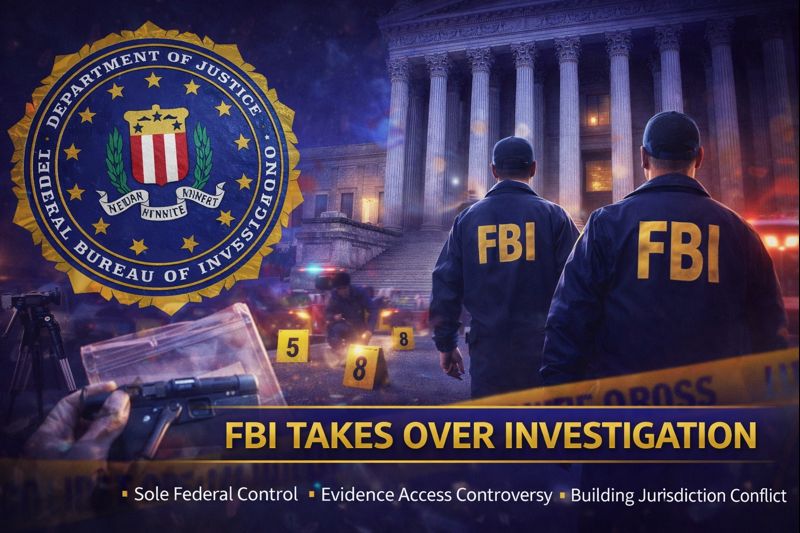
Minnesota’s Bureau of Criminal Apprehension said it could not continue a joint investigation because it was denied access to evidence and witnesses, leaving the FBI as the sole authority. (AP News)
That matters for three reasons:
- Public confidence: a sole federal investigation into federal conduct creates an inevitable perception problem—fair or not.
- Evidence control: who holds bodycam, phone footage, and scene access shapes the narrative and legal outcomes.
- Political escalation: state leaders can frame federal control as “stonewalling,” while federal leaders can frame state demands as obstruction.
The Guardian and WSJ both described the state’s exclusion and the resulting backlash, reinforcing that the jurisdictional dispute is now central to the national conversation. (The Guardian)
AP — The Latest: State investigators say they can’t access evidence after FBI takes case
https://apnews.com/article/b974e9edabddb8db83abacdd37ae4fa5
The victim at the center: who Renee Nicole Macklin Good was
AP reporting described Renee Good as a Minneapolis mother with no criminal record and noted community shock at the “domestic terrorism” characterization. (AP News)
Local reporting added eyewitness claims that she posed “no threat,” underlining why the video debate matters. (MPR News)
In incidents like this, identity becomes part of the story’s gravity: how the public sees the victim shapes political pressure, institutional risk, and what reforms become possible.
The enforcement context: why “immigration enforcement surge 2026” is the real storyline
Even without this shooting, the broader enforcement picture was already escalating. Reuters described the Minneapolis incident in the context of a wider enforcement push and growing tensions between federal operations and local leaders. (Reuters)
When enforcement expands rapidly, three predictable stress points follow:
- Operational friction: rushed operations increase risk, especially in complex environments.
- Community backlash: cities see raids differently than federal agencies do.
- Narrative warfare: officials front-load claims to control public perception before evidence is fully reviewed.
This is why the Minneapolis case is being read nationally as a proxy for what “surge” means on the ground.
Use of force in vehicle-related encounters: why this becomes legally fraught
A major disputed question is whether the vehicle posed an immediate threat and whether deadly force was justified.
Across U.S. policing debates, vehicle-related use-of-force cases are uniquely explosive because:
- Vehicles can be lethal instruments.
- Situational awareness is often poor (noise, crowds, weather).
- Split-second judgments are later evaluated frame-by-frame.
Investigators typically examine: trajectory, speed, officer position, escape routes, and whether officers moved into the vehicle’s path. That technical reconstruction—plus video—often determines whether “self-defense” is legally credible.
The Minneapolis case is especially sensitive because competing authorities are referencing video to argue opposite conclusions. (Reuters)
The information war: why this story went viral immediately
This case is a modern example of “two realities” forming fast:
- Reality A (official-first): press statements shape first impressions.
- Reality B (video-first): clips shape belief before statements are trusted.
Reuters, AP, and other reporting all indicate video is central to public dispute, and local leaders explicitly cite it. (Reuters)
Once a story becomes video-driven, it stops behaving like traditional news. It becomes a social distribution event—fast, emotional, and algorithmic. That’s why your broader editorial strategy matters here: what your outlet publishes first and what it updates later can determine whether audiences trust your coverage.
Daily AI News: Your Indispensable Tech Briefing for January 1, 2026
https://theviralminute.com/daily-ai-news-your-indispensable-tech-briefing-for-january-1-2026/
The political blast radius: Jacob Frey, Kristi Noem, and the nationalization of a local tragedy
This story has instantly nationalized because it features:
- A Democratic city leader disputing federal claims (Mayor Jacob Frey). (Reuters)
- A Republican DHS leadership defending the agent and using maximal framing (“domestic terrorism”). (AP News)
- A federal decision to centralize the investigation under the FBI. (AP News)
That is the kind of alignment that turns one incident into a national referendum on enforcement, civil liberties, and executive power.
What changes next: the scenarios that matter
Scenario 1: Video corroborates federal claims
If full footage supports an imminent threat narrative, DHS gains leverage and critics must shift to oversight questions (why the operation happened there, how it was planned, why transparency failed).
Scenario 2: Video supports local leaders’ claims
If footage shows the car moving away and no imminent threat, the story becomes not only a use-of-force controversy but a credibility crisis for federal leadership—particularly after “domestic terrorism” language was used early. (The Guardian)
Scenario 3: Evidence remains fragmented
If there is no decisive footage, trust collapses further and pressure grows for independent oversight, congressional inquiry, or civil litigation.
In all scenarios, the investigation’s legitimacy becomes as important as its result.
What happens next: timelines and accountability pathways
- Short term (days): evidence collection, witness interviews, broader protest response, and more video surfacing. (Reuters)
- Medium term (weeks): findings summaries, potential administrative review actions, and political oversight escalation.
- Long term (months): prosecutorial decisions, civil litigation, and policy reforms driven by public pressure.
FAQs
Was this an “ICE raid” or another kind of operation?
Reporting describes it as a federal immigration enforcement operation involving ICE; specific operational details may evolve as investigators release more information. (Reuters)
Why did the FBI take over?
AP reported Minnesota’s BCA said it was denied access and the FBI became the sole authority—an unusual structure that intensified political conflict. (AP News)
What did Mayor Jacob Frey say?
Reuters reported Frey disputed the self-defense narrative after reviewing video. (Reuters)
Why is Kristi Noem involved?
As DHS Secretary, she publicly defended the agent and described the incident using “domestic terrorism” framing, which local leaders dispute. (AP News)
Where can I follow reliable updates?
Reuters and AP have ongoing updates; Minnesota outlets like MPR provide detailed local reporting. (Reuters)
What’s the bigger significance?
It’s becoming a defining test of the immigration enforcement surge 2026, especially around transparency, local-federal coordination, and use-of-force rules.
Conclusion
The Minneapolis case is no longer just about a single fatal shooting. It is the most visible stress test yet of the immigration enforcement surge 2026—how it is conducted, how it is explained, and whether public institutions can maintain legitimacy when video evidence and official claims point in different directions. The next phase isn’t only investigative. It’s political, legal, and cultural—and it will shape how enforcement is judged in every major U.S. city watching this unfold.
If you want, I can also produce the Day 4 featured image (16:9) + metadata, a 60-second roundup graphic script, and NewsArticle + FAQPage JSON-LD for this pillar post.