

Introduction: Why Oil Markets Are Back at the Center of Global Power
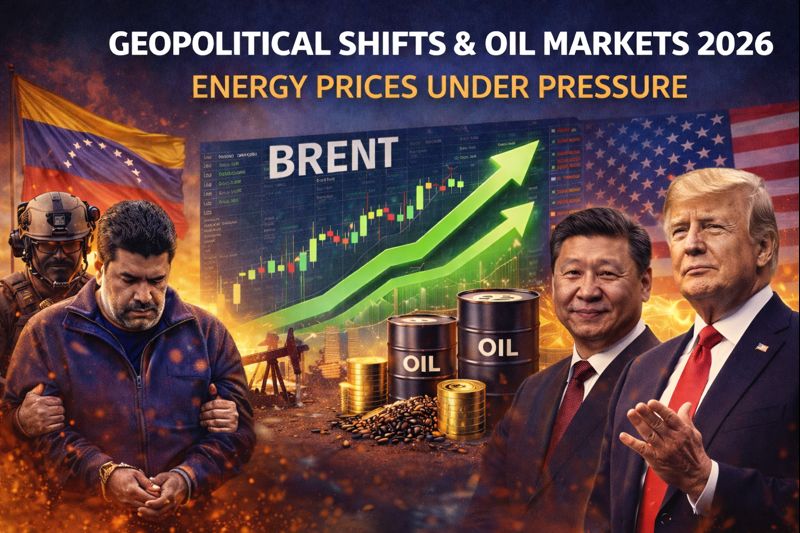
As 2026 begins, oil markets are no longer being shaped by supply-and-demand math alone. Instead, geopolitical shifts and oil markets have become inseparable, with courtrooms, conflict zones, and diplomatic chambers exerting as much influence on prices as drilling rigs and refineries.
In the past week alone, events stretching from Manhattan to Caracas and from Washington to Beijing have sent clear signals to traders: energy is once again a geopolitical instrument. The arrest and prosecution of a sitting head of state, renewed U.S. involvement in Latin America, and intensifying great-power rivalry are forcing markets to reprice risk—fast.
For governments, oil is leverage. For investors, it is exposure to global instability. For consumers, it determines inflation, transportation costs, and economic confidence. That is why understanding how geopolitical shifts are driving oil markets in 2026 is no longer optional—it’s essential.
This pillar analysis breaks down what is happening, why it matters now, and how energy markets are being reshaped in real time.
Key Facts at a Glance
- Primary theme: Geopolitical shifts and oil markets
- Key regions: Venezuela, United States, China, Russia, Middle East
- Market impact: Rising risk premiums, oil price volatility
- Who is affected: Energy producers, investors, governments, consumers
The Venezuela Shock: Politics Rewrites Energy Risk
The prosecution of Nicolás Maduro in the United States marks one of the most disruptive geopolitical moments for oil markets in years. Venezuela holds some of the world’s largest proven oil reserves, yet its output has long been constrained by sanctions, mismanagement, and political isolation.
Now, the situation has escalated from diplomatic pressure to direct legal and military involvement.
Why Venezuela matters to oil markets
- It represents massive untapped supply
- Any regime change alters sanctions policy assumptions
- Markets must price in uncertainty, not optimism
Even without immediate production changes, oil traders react to expectations. The idea that Venezuelan oil could eventually re-enter global markets—under U.S. oversight or international restructuring—forces traders to reassess long-term supply curves.
In 2026, oil prices are increasingly reacting not to barrels moved today, but to barrels that might move tomorrow.
For full context on how Venezuela’s political crisis escalated into a market-moving event, including U.S. involvement and the capture of Nicolás Maduro, read our in-depth report:
https://theviralminute.com/what-happened-in-venezuela-us-strikes-and-capture-of-president-maduro/
U.S. Strategy: Energy Security as Foreign Policy
The United States has re-embraced energy as a strategic tool. By framing actions in Venezuela as a “law-enforcement mission,” Washington is signaling something broader: oil security is national security.
For markets, this has two immediate effects:
- Short-term risk premiums rise due to instability
- Long-term supply narratives shift as U.S. influence expands
American policymakers understand that controlling energy flows indirectly shapes inflation, growth, and geopolitical leverage—especially against rivals like China and Russia.
This is why energy markets in 2026 respond to U.S. press conferences almost as quickly as they respond to OPEC announcements.
China and Russia: Why Oil Is a Power Counterweight
Reactions from China and Russia have been swift and pointed. Both governments framed U.S. actions in Venezuela as destabilizing, not just politically—but economically.
Why Beijing and Moscow care
- Both rely on energy leverage to project power
- Oil instability threatens global trade flows
- U.S. intervention challenges multipolar energy control
China, in particular, views oil security as central to its long-term growth. Any increase in Western control over supply routes raises strategic alarms. As a result, geopolitical shifts are pushing China to:
- Diversify energy partnerships
- Accelerate alternative supply chains
- Hedge aggressively in commodity markets
This tension feeds directly into oil price volatility.
OPEC’s Dilemma in 2026
The OPEC cartel faces an unusually complex environment. Traditional production management is now complicated by:
- Sanctions politics
- Military interventions
- Legal uncertainty around producers
When geopolitics injects instability, OPEC must choose between:
- Increasing output to calm markets
- Holding back supply to maintain pricing power
Either choice carries political consequences. As a result, oil markets remain hypersensitive to every signal from cartel leaders.
Why Oil Prices Spike Even Without Shortages
A common misconception is that oil prices rise only when supply drops. In 2026, prices often move before anything actually changes.
That’s because modern oil markets price:
- Risk, not just reality
- Intentions, not just output
- Political trajectories, not just production
The Venezuela crisis illustrates this perfectly. No immediate supply collapse occurred—yet prices reacted. Markets are responding to the possibility of disruption, not confirmation.
Impact on Energy Stocks and Investors
Energy equities often act as a geopolitical barometer. When uncertainty rises, investors rotate into companies with:
- Strong balance sheets
- Stable production
- Global diversification
Major energy firms benefit from higher oil prices, but face longer-term policy risk as governments push energy independence and transition strategies.
For investors, geopolitical shifts and oil markets create a paradox:
- Short-term gains from volatility
- Long-term uncertainty from political intervention
Energy markets are already reflecting this geopolitical risk premium, with major oil stocks moving alongside crude prices. We break down one key market mover here:
https://theviralminute.com/xom-stock-surges-why-exxon-mobil-is-back-in-focus-right-now/
Economic Consequences Beyond Energy
Oil is embedded in almost every sector. Rising prices ripple outward:
- Transportation costs increase
- Food prices face pressure
- Inflation expectations rise
Central banks watch oil closely because it directly affects interest-rate decisions. In 2026, geopolitical energy shocks complicate already fragile global economic recoveries.
What Happens Next: Scenarios for 2026
Scenario 1: Stabilization
- Diplomatic de-escalation
- Clear framework for Venezuelan oil
- Gradual price normalization
Scenario 2: Prolonged Volatility
- Continued geopolitical tension
- Fragmented supply chains
- Persistent oil price swings
Scenario 3: Escalation
- Expanded sanctions or conflict
- Retaliatory energy policies
- Sharp oil price spikes
Markets are currently pricing a mix of scenarios two and three.
Frequently Asked Questions
Why are geopolitical shifts affecting oil markets so strongly in 2026?
Because energy is increasingly used as a strategic and political tool, not just a commodity.
Does Venezuela still matter to global oil supply?
Yes. Its reserves make it geopolitically significant even with low current output.
Are higher oil prices inevitable?
Not inevitable, but volatility is likely as long as geopolitical uncertainty persists.
How do oil prices affect everyday consumers?
Through fuel costs, inflation, and higher prices across goods and services.
What role does the U.S. play in oil markets now?
A growing one—through diplomacy, enforcement, and strategic energy policy.
Will energy transition reduce geopolitical oil risk?
Over time, yes—but in 2026, oil remains central to global power.
Related coverage from The Viral Minute:
- Venezuela Crisis Explained: US Strikes and Maduro’s Capture
https://theviralminute.com/what-happened-in-venezuela-us-strikes-and-capture-of-president-maduro/ - CES 2026 and the AI-Driven Economy
https://theviralminute.com/ces-2026-previews-emotional-ai-breakthroughs-why-this-tech-shift-matters-now/ - Why Exxon Mobil (XOM) Is Moving With Oil Markets
https://theviralminute.com/xom-stock-surges-why-exxon-mobil-is-back-in-focus-right-now/
Conclusion
In 2026, oil is no longer just a resource—it is a geopolitical signal. Court decisions, diplomatic statements, and military actions now move markets as decisively as drilling reports.
Understanding geopolitical shifts and oil markets is key to understanding the global economy itself. As power realigns and energy security takes center stage, oil prices will continue to reflect not just what the world consumes—but how the world governs itself.



Pingback: Explosive US Iran Israel Conflict 2026 Update: The Shattering February Ultimatum